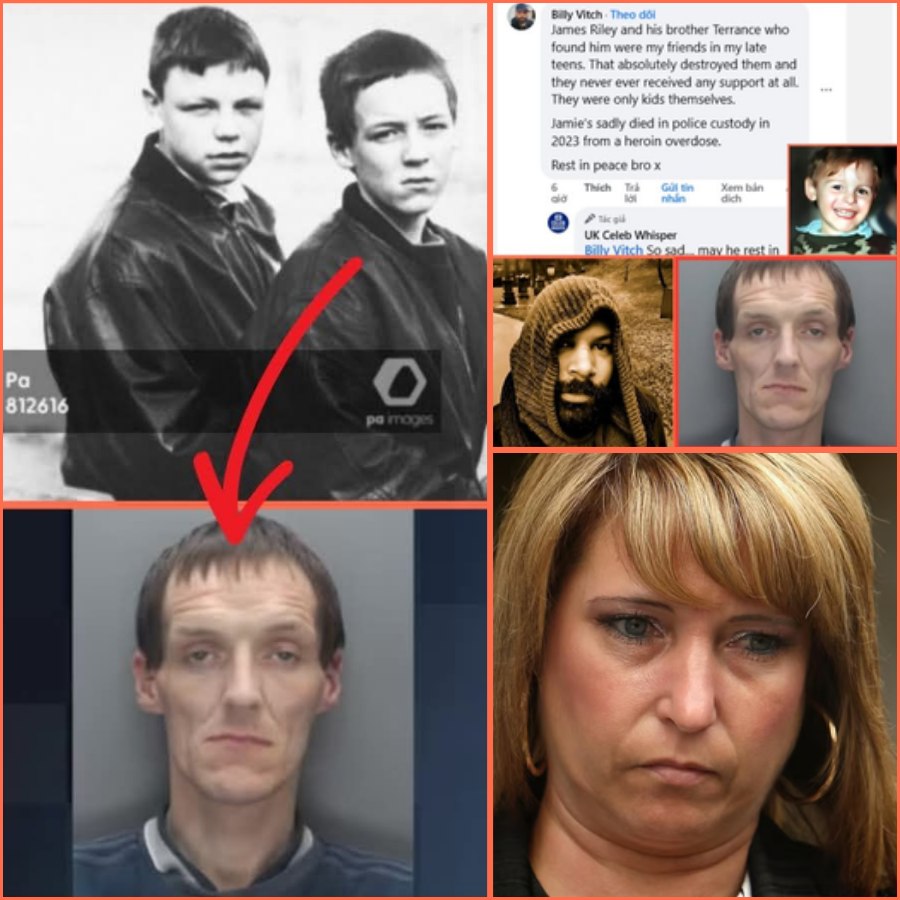
Billy Vitch Breaks Silence on the Tragic Life of James Riley — The Teen Who Found James Bulger’s Body and Never Recovered

Liverpool, UK —
Three decades after one of Britain’s darkest crimes, Liverpool photographer Billy Vitch has spoken publicly about two forgotten names in the James Bulger case — James Riley and his brother Terrance — the teenagers who stumbled upon the murdered toddler’s body in 1993.
In a moving Facebook post, Vitch wrote:
“James Riley and his brother Terrance, who found him, were my friends in my late teens. That absolutely destroyed them and they never ever received any support at all. They were only kids themselves.
Jamie’s sadly died in police custody in 2023 from a heroin overdose. Rest in peace bro x.”
The Day That Changed Their Lives Forever
It was a grey February afternoon in 1993 when 14-year-old James Riley and his younger brother Terrance made a discovery no child should ever face.
They were crossing a disused railway line near Walton, Liverpool, when they came across the body of two-year-old James Bulger, whose abduction from the Strand Shopping Centre had already horrified the nation.

The country soon learned that two ten-year-old boys — Jon Venables and Robert Thompson — were responsible. Their trial and conviction became a global media storm. But for the Riley brothers, the story was not a headline; it was a trauma that would haunt every day that followed.
“People forget that there were kids who found that poor boy,” Vitch said later. “They were just kids — and it broke them.”
Despite the magnitude of what they witnessed, the brothers received no structured psychological help. There were no counsellors, no trauma specialists, no follow-up. The system simply expected them to “get on with life.”
From Witness to Victim
Friends and former neighbours recall that the cheerful Liverpool teenager faded after 1993.
Riley struggled to sleep, turned anxious and withdrawn, and by his late teens had drifted into heavy drinking. Substance use soon became addiction, and by adulthood he was caught in a cycle of drugs, petty crime, and short prison sentences.
According to reports from ITV News and The Sun, Riley accumulated more than 40 convictions for theft, disorder, and drug-related offences. Those who knew him say the behaviour wasn’t born of malice but of untreated trauma.
“He was a good lad, just broken inside,” one former friend said. “He saw something no child could handle, and nobody ever helped him deal with it.”
Professionals later suggested he showed symptoms of post-traumatic stress disorder (PTSD) — nightmares, anxiety, depression — but he never received consistent therapy. Instead, he self-medicated with alcohol and heroin.
A Life Cut Short
By the early 2020s, Riley was living a fragile existence, alternating between short-term accommodation and the streets.
In March 2023, at the age of 44, he was found unresponsive in a Liverpool police cell after being detained overnight. Authorities reported a heroin overdose; the Independent Office for Police Conduct (IOPC) opened an investigation.
His death barely made the news — a small paragraph in local crime briefs — until Billy Vitch’s Facebook tribute reignited public memory.
“Jamie was failed,” one community member commented. “He found a murdered child and nobody cared how that affected him. Of course it changed him.”
Billy Vitch’s Voice Echoes Through Liverpool
For Vitch — a well-known figure in Liverpool’s rock and arts scene — speaking out was personal.
He had known the Riley brothers during their teenage years and says the trauma was visible even then.
“They were quiet, troubled lads,” he recalled in messages later shared by local pages. “It wasn’t fame or infamy — it was pain.”
His post has since been shared hundreds of times, sparking conversations about the long-term psychological effects of witnessing violence and the failure of the system to support young people exposed to crime scenes.
The Forgotten Victims of Violence
While the James Bulger case remains one of Britain’s most infamous murders, the ripple effects of that tragedy have received far less attention.
Experts say children who witness or discover the aftermath of violence often suffer the same symptoms as direct victims — including chronic anxiety, substance abuse, and self-destructive behaviour — if left untreated.
Riley’s story is, in that sense, a cautionary tale: how a child once drawn into a national tragedy was slowly consumed by it.
Thirty years on, his death has become a symbol of what happens when trauma is ignored.
Rest in Peace
James Riley (1979 – 2023) never sought fame, never wanted attention. He was a boy who once found tragedy and could never escape it.
And thanks to Billy Vitch, his name — and his pain — are finally being remembered.
“Rest in peace, Jamie,” Vitch wrote. “You deserved better.”
Suggested Header Image
For a respectful, non-graphic visual:
- A candle glowing beside railway tracks at dusk, blurred background.
- The Liverpool skyline at sunset with a single light or flower in foreground.
- Caption: “In memory of James Riley — gone, but never forgotten.”